Posts Tagged 'schools'


Fire Two Teachers and Call Me in the Morning.

Fire Two Teachers …

“Fire two teachers and call me in the morning …” seems to be the cure-all that neo-liberal and right-wing activists are banging their drums for. The next move after the “ABCD-F” scam will be to legislate recognition of mail-order teaching degrees from online diploma mills. Wanna bet? Recall that our secretary-designate of education has placed on her PED Advisory Board David Saba the CEO of the American Board for Certification of Teacher Excellence, a private company and publisher of self-paced online teaching certification programs. The  train is coming down the tracks right now as public schools, public school teachers and teaching are attacked and denigrated.

Another private organization, “National Council on Teacher Quality” has published a little document titled a bit disingenuously, “Increasing the Odds – How Good Policies Can Yield Better Teachers“. The ultimate purpose of this document published in 2004 is to disenfranchise university and college-level schools of education and, most importantly, teachers and teachers’ unions. It is a call to dumb down the practice of teaching and learning to the extent that the authors claim there is no value to be gained from teachers earning masters’ degrees. So much for the value of education.

A problem cannot be solved without at least some measure of understanding and historical perspective as to what exactly the nature of the problem is and how it was arrived at. In other words, what are we talking about when someone says public education is failing? The condemnation of public education is a manufactured stampede to the destruction of that institution. The public needs to ask a lot of questions about the motives and intended purposes behind this condemnation. How are schools failing? Why are they failing? How did this all begin, when and where?

This entire early 21st century school reform argument is, I think, fueled by organized pretense and sophisticated public relations propaganda. When someone presents solutions to a problem without clearly defining that problem and its nature their motives and methods are to me suspect. When rapacious billionaires like Rupert Murdoch salivate for their piece of what they see as a lucrative education market, something other than authentic school reform is on their minds. Last year when Rupert acquired a school performance tracking firm, Wireless Generation, his take was, “When it comes to K-through-12 education, we see a $500 billion sector in the US alone that is waiting desperately to be transformed.” Murdoch later told an assembly of educational reform crusaders in San Francisco this past October, “Put simply we must approach education … willing to blow up what doesn’t work or gets in the way.” This week (11/15/11) the Walton (Wal-Mart) family’s foundation gave $25.5 million to the KIPP charter school system.  Public schools, public school teachers and teachers’ unions beware – you are definitely in their way. You are on the target list. Duck and cover isn’t going to do it for you either, you are going have to come out swinging if you want to survive this onslaught.

SOME PERSPECTIVE

The problem with public education and the solution appeared with the George W. Bush administration and, as a result, we were “gifted” with the No Child Left Behind (NCLB) scam. The program, when stripped of its rhetoric, is essentially a testing regime starting with children as young as 4 years of age. Tests emanating from Washington DC and prepared by private testing companies, as might be expected, determined that kids were not learning to read and do arithmetic. Soon school systems, in order to retain federal funding, were pursuing better NCLB test scores by one means or another and you may recall the scandal that happened in Georgia. Atlanta teachers, on orders from their administrators, were altering test scores. Other teachers around the country began “teaching to the test”. Suddenly public education was on the ropes.

In my estimation, NCLB is the domestic propaganda equivalent of Iraq’s WMD – a problem created to rationalize and facilitate a “solution”. Another gift from the Bush dynasty, including brother Jeb who overnight became an education expert. And who were the beneficiaries of this gift that keeps on giving – kids, teachers, the public? Seed Money for Conservatives spells out who got the goodies: Shortly after the act was born in 2001 the US Department of Education doled out nearly $78 billion via NCLB to “private, for-profit and/or religious schools.” The two principle actors at the Department of Education at that time were Eugene Hickok and Nina Shokraii both with long histories with pro-privatization outfits like the Heritage Foundation and Americans for Tax Reform.

While the Bush 2005 budget provided the smallest spending for education compared to the nine preceding years, a $50 million experiment for school vouchers was approved diverting that money from public schools to private ones. From 2001 thru 2003 the US Department of Education gave $77.76 million to various groups all advocates for privatized education, including K12, founded by William Bennett. (Remember him?) You might recall our current secretary-designate of education, before she was posted to NM, was the CEO of Laying The Foundation, Inc. a private teacher training company. If you have harbored any doubts about what this new wave of school reform is about you now have a few things to think about.

WHAT IS THE PROBLEM?

In the late 1800s when mass public education was in its infancy social needs and conditions were very different from what they are now. Public schools taught personal hygiene with as much intensity as they taught the alphabet. Why? Because living conditions were enormously different in those times. Punctuality was a major curricular objective among the teaching objectives in city schools in those times. Why? Because employers wanted reliable employees who could be counted upon to arrive at work on time and be prepared to carry out their tasks. The first writing on curriculum and instruction in the US was the work of industrial efficiency experts and academics such as Elwood Cubberly, who in 1905 had this to say about the purpose of public education:

“[Schools should be factories] “in which raw products, children, are to be shaped and formed into finished products…manufactured like nails, and the specifications for manufacturing will come from government and industry.” – Elwood Cubberly, Dean of Education at Stanford (1905)

LEARNING TO LEARN

What do children today need to learn in order to have a successful future life? A child entering public school this past September will not enter the work force, at the earliest if he or she matriculates from high school, until 2025. Who even has a clue what the world will be like in 2025? And therein lies the rub.

After a life-long involvement in teaching – elementary school children to graduate students – I will say without hesitation and without diminishing the value of other essential skills – learning to learn is, the most vital skill anyone can acquire. While content rapidly becomes obsolete the skill of learning lasts a life-time. Firing or demeaning teachers because students aren’t learning to read at a rate determined by someone who doesn’t know the individual children is a scam to justify hiring low-cost educational workers, installing high-cost teaching machines and hiring expensive “consultants”.

Testing is not by any stretch of the imagination teaching and it ought not to be the curriculum either. Razzle-dazzle machines are not teachers they are merely an impoverished implementation of low-level Skinnerian operant conditioning. Schools are not factories, children are not “products” to be “manufactured” and public education is not a market to be exploited . Teaching and learning are human-to-human activities, and this process has been going on since pre-historic times. The simple fact that we are still on the planet suggests success for the relationship. Let’s keep it that way.

This essay was first published at:  http://NMPolitics.net
Undermining Public Education

Skandera takes steps to undermine public education

It’s no surprise that N.M. Education Secretary Designate Hanna Skandera is taking steps to undermine public education. The problem is that the educational model she and her backers pursue isn’t education at all. It’s operant conditioning.

Earlier this year I wrote about the questionable nomination of Hanna Skandera to the post of New Mexico secretary of public education – a job for which she is, on evidence, unqualified. Given her lack of a proper background and experience as an educator I wondered just what she was about.

As it turned out, Skandera failed to be confirmed for the secretary position during the 2011 regular session and so has held her office as “secretary designate.” Since holding this office, and without the mandate accorded by legislative approval, she has taken steps designed to undermine the authority of the Public Education Commission and the future of public education in the state.

Ms. Skandera came to New Mexico with a mission – to undertake the process of privatizing public education. She came here under the auspices and/or recommendations of various right-wing “foundations” and “institutes.” In some of them she had previously served as an officer.

Ms. Skandera and New Mexico are not alone in this scheme, as she has numerous counterparts across the country, all paid for by the same cabal of wealthy and influential individuals who underwrite the so-called “foundations” and “institutes” that finance their industrialized vision of public school reform. Here in New Mexico, Skandera has the backing of one of those so-called “foundations,” that being the Rio Grande Foundation and its chief executive Paul Gessing.

The majority of financial support for this “foundation” comes from out-of-state “foundations” and donors. Gessing’s donors include, among others, Donor’s Capital Fund of Virginia, State Policy Network of Virginia, Roe Foundation of South Carolina, Wal-Mart of Arizona and the Atlas Foundation of Washington DC.

A clear warning of an agenda

The obvious duplicity and fact-torturing employed by these so-called “foundations” and “institutes,” which are underwritten by some of the wealthiest people in the United States, ought to be a clear warning to all that they have an agenda. The shuck and jive surrounding their propaganda is patently transparent. What they are after is to defame, de-unionize, scrap and then privatize public education across the United States.

They are beginning with the founding and underwriting of variations on the charter-school theme. Charter schools, across the board, do not have a better academic record than their public school counterparts. What they do offer is that they are generally free of teachers’ unions, a holy grail for the sponsors on their path to privatization.

The efforts of these groups and their agents are sometimes clumsy and ham-handed but in so being they reveal the true nature of what they are up to. For example, Ms. Skandera just recently overruled the N.M. Public Education Commission’s (PEC) decision to not renew the credentials of three charter schools that utterly failed to meet required academic standards. To ensure she has legal cover for her actions, Skandera’s Public Education Department (PED) has now hired Patricia Matthews, who comes from the staff of a law firm that provides legal services to charter schools. The event was characterized by a member of the PEC as, “…hiring a fox to guard the hen house.”

Skandera also tailored the qualifications for a position within her department so she could hire the wife of the governor’s right-hand man. These antics are, to put it into the campaign rhetoric of our current governor, “Crony” hiring. So much for promised reform on that score.

Foot soldiers for the financially powerful

Why so blatant? Why the arrogance? Perhaps it arises from a sense of hubris gained by knowing you have the backing of wealth beyond the dreams of avarice that wants to become even more wealthy, and you can help.

Being a foot-soldier for the financially powerful has been known to confer delusions of elevated status to certain individuals. To get the picture, one has only to listen to Governor Scott Walker of Wisconsin, who is doing his best to cut funding for public education at all levels in his state and disenfranchising teachers’ unions, speaking to someone he thought was one of the Koch brothers in this audio recording.

It is also worth noting that Governor Martinez’s campaign reports show that she took $10,000 directly from Koch Industries and $1.3 million from the Republican Governors’ Association. The RGA, for its part, took in at least $1 million from the Koch brothers and donated more than a million to the Republican Party of New Mexico, which heavily aided Martinez’s campaign.

The Koch brothers are businessmen – they expect a return on their investments, and you can rest assured they’ll have business in the Land of Enchantment.

Here is the agenda

Why do I object so strenuously and so strongly to all of the above? I do so because the industrialized education model being pursued by activists such as Skandera and her backers is an endless cycle of memorizing and regurgitating – no critical thinking, no creativity and, above all, no challenging of conventional wisdom or authority. The kind of training proposed by these people is not education – technically, it is operant conditioning.

Bill Gates, who invests heavily in this kind of educational reform through his own “foundation” once told an interviewer that any form of teaching and learning that could not be measured is useless. When was the last time you measured a beautiful sunset? How would you quantify the beauty of a Mahler symphony? Human beings have hearts and minds, Mr. Gates, not CPUs.

Conditioning of this kind is a dead end from which there is no exit. A better conception of the future will be impossible, because not only would the majority of children be unable to imagine such, they also wouldn’t know how to measure it. Children so conditioned would be left with no sense of authenticity or agency to shape their lives beyond low-paying, low-skill, treadmill jobs. Their lives and imaginations would be impoverished and, consequently, so too would be the world in which they would have to live.

People cannot have a better life or fashion a better world if they cannot imagine it, if they cannot imagine themselves creating it. Destroy imagination and you destroy tomorrow.

If people want more for their own children and if people who have no children want more for themselves, they must come to understand that today’s children will shape everyone’s future. We must all see our investment in public education today as an investment in our own futures, an investment in a civilized social contract, in a creative and thriving society.

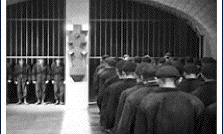
Metropolis

scene from Fritz Lang's "Metropolis"

The moral of Fritz Lang’s film “Metropolis” is that between head and hands there must be a heart. It is a heartless world imagined by those such as Skandera and her sponsors, those who would privatize and industrialize public education.

The More Things Change…

Plus ca change, plus c’est la meme chose…

As I started to outline my thoughts for this essay, The More Things Change, the More They Stay the Same, I recalled my first day in tech school at Sheppard Air Force Base in Texas in 1961, learning how to maintain and launch an Atlas-F ICBM. I was a brand new 2nd Lieutenant in a group of about 20 officers ranging from “Brown Bars” like me to Lt. Colonels. The introduction was delivered by a young 1st Lt. who was enthusiastic to the point of delight about how modern warfare would never be the same because of these amazing ICBMs. The fellow rattled off dazzling statistic after dazzling statistic about range, targeting accuracy, response time, time to target and so on. The guy was absolutely glowing as he addressed the mixed group of newbies and old hands about the amazing capabilities of the Atlas F weapon system and a future of space travel, orbiting space stations, men on the moon and so on. For the time, it was all Buck Rogers whiz-bang.

At this point in the presentation there was a rather loud “Harrumph!!”. I looked back as a grizzled Captain, obviously recalled from retirement to active duty, growled loudly, “Aw, baloney! I’ll bet anybody anything that the day they land a man on the moon there’ll be a Goon in the pattern with fresh fruit and vegetables.”


(C-47 a WWII era cargo aircraft affectionately known in the AF as the “Gooney Bird” in which the author flew  when he was first on active duty in 1961.)

Of course the class broke into gales of laughter – you had to be there I suppose – everyone enjoyed the counter-point. This guy had flown very many combat missions, had been shot at on numerous occasions and wasn’t terribly impressed with the idea of sitting in an underground bunker waiting to launch a missile at someone half-way around the planet he couldn’t see.

When I read the front page story in the Sunday, September 4th, New York Times, In Classrooms of Future, Stagnant Scores, I heard myself say, “Aw Baloney!” and I felt much the same way the Captain must have. The article cited details the introduction and use of high tech devices in a school system in Chandler, Arizona. This community has so far spent 33 million dollars to acquire the latest and greatest educational whiz-bang gadgets to outfit their schoolrooms. The article goes on to report that, “… schools are spending billions on technology, even as they lay off teachers, with little or no proof that this approach is improving basic learning.” The Chandler story is being repeated across the country as schools acquire the latest gadgets and get rid of teachers.

Frankly, I think we have slipped our intellectual and moral anchors and are now rapidly drifting off into an ocean of gullibility and hidden agendas. School officials are behaving much like Pacific island cargo cults waiting for that magical ship to sail over the horizon bearing all the answers to successful standardized test scores so they can beat the No Child Left Behind rap. They are bereft of good ideas of their own and are desperate. How did we come to this and what other ideas are possible?

WHAT’S THE REAL DEAL?

The “real deal” isn’t gadgets, it isn’t holding back and it certainly isn’t social promotion either. It isn’t bogus programs like No Child Left Behind. Those lame ideas have been and are being proven wrong over and over again – ad nauseum. Some things actually do work however and we need to ask, what is it that the successful charter schools do that regular public schools don’t? Are the technos ready for this brain-exploding revelation? 5 – 4 – 3 – 2 – 1 …… They spend more time with kids!Eeeeeek! More time? That means more teachers and tutors. That means more mentoring. We don’t want to pay for more humans but …. maybe there’s a machine we can buy that will do the job.” There is more to the “Eeeeeek!” factor, however, and we’ll get to that later.

In contrast to the Chandler experience, in Houston, Texas the Schools Superintendent is experimenting with – are you ready for this?  Here it comes !!!! ….. More time, More teachers, More tutors, More mentoring. And, as a result, the educational/instructional outcomes are improving. Troubled Schools Try Mimicking the Charters

There were five policies identified by the fellow who consulted with the Houston school system that he deemed “common to the successful charters” and these were:

  • Longer school days and years.
  • More rigorous and selective hiring of principals and teachers.
  • Frequent quizzes to determine what needs to be retaught – and “high dosage tutoring”.
  • A “no excuses” culture.

To this end, the Houston school cited in the story hired 50 full-time math tutors. More teachers, more tutors, more of the most essential ingredient in successful teaching and learning – one-on-one contact between teachers and learners. The tutors come from various backgrounds and the one cited in the story was formerly an engineer who easily illustrated how “negative 7 and positive 7 have the same absolute value” to a struggling student by drawing a number line for her. This is not unlike a master carpenter showing an apprentice how to square a layout – this is teaching as it has been done for as long as adults have been passing knowledge to young people.

Machines do not understand when a child is “struggling”, machines cannot interpret a puzzled look on a child’s face, machines cannot sense emotion and allay fear and uncertainty with a pat on the back or an encouraging word as can an adult who knows the child. These are the strong and irrefutable reasons why caring humans are the first and best teachers of other humans. And, it should go without saying that there have to be enough teachers, tutors and mentors to go around.

I am not at all opposed to the use of technology in classrooms as such. In these 21st Century times marvelous devices can be employed to extend the reach of teachers but, it must always be understood, machines cannot replace human teachers. Why? Because we are not talking about assembly lines and robots we are talking about schools and children. My values embrace personal achievement as opposed to standardized test scores and advocacy for children as distinct from advocacy for social promotion and holding back. Teaching a kid with the object of passing the NCLB test is not by any stretch of the imagination education. My advocacy is also a position with moral dimensions: we unquestionably devalue humanity by assigning to machines what is the essentially human task of people teaching people and when we demean a child with the humiliation of being held back. We have only to ask: What human values are transmitted to a child by a machine? What values are transmitted by humiliation? Who, in these circumstances is the ultimate beneficiary?

We must question why remedies are being proposed which are essentially punitive and not educative as to subject matter. We are justified in asking what other agendas might underlie policies that are essentially more political than educational. As a public policy, holding children back in grade is not about education but more a manipulation of public perception. The proposed policy of ending social promotion is no more than a Trojan Horse laying the ground work for selling out public education to the lowest bidder. This is the “Eeeeeek!” factor I alluded to earlier, this is the hidden agenda we must be alert to.

If we wish to promote a humane society, the teaching learning enterprise must then always be humane and human. In the final analysis there must always be teachers in the pattern, caring human teachers doing what teachers have been doing for eons – teaching children, passing on our collective knowledge and our collective societal values, which values include recognizing and respecting each other’s humanity – it cannot be about profit. Morally, the responsibility and execution of public education must always remain public. There is no other way to create and maintain a humane, just and civilized society except as a public enterprise.

Ditch the Corpse

DITCH THE CORPSE

Both social promotion and holding children back in grade for failing to achieve according to arbitrary standards are counterproductive. The first is a disservice, the second a punishment. Both of these notions constitute a fundamental denial of the learning process and could easily be eliminated from the current educational narrative in one fell-swoop by simply eliminating grade levels.

If there were no grade levels from what are now considered kindergarten or first grade to 5th or 6th grade levels and if instead achievement or developmental levels were the gauge there would be no social promotion and no holding back. Nothing can change the simple fact of life that all  learning is personal and is accomplished at a rate appropriate to each individual.

So, what’s the deal here with this urgent push to end social promotion and replace it with the Draconian practice of holding back? What personal, social or political agendas are being served by demeaning and humiliating children with this form of punishment? Is there an assumption that children who do not learn according to arbitrary expectations are doing so deliberately? Have any of those who are making these proposals ever taken instruction in human developmental psychology? We are not talking about Skinnerian pigeons here, we are talking about children – human children – and it is a given that all humans, children and adults, learn at their own rate according to their abilities. (n.b.: Not all of Skinner’s pigeons learned at the same rate either.) I would ask the so-called reformers who propose the holding-back policy how well they would do today in a differential equations class. How would they feel if they were socially stigmatized for not keeping up with others who are more mathematically inclined in a chat about Newton’s thoughts on the Binomial Theorem for Fractional or Negative Exponents?

What do the proponents of holding children back believe would be gained by social stigmatization? Do those who propose this antediluvian educational practice believe they are actually helping a child when they humiliate him or her in front of peers, and are they presuming to speak for the child and assert there is no need to feel humiliated? Do they want not only to specify how quickly a child should learn but also tell the child how to feel about being held back? This sounds to me a lot like adding insult to injury.

ARE THERE ALTERNATIVES?

How can anyone claim with a straight face that cutting school budgets, eliminating teachers, shortening the school day or week and limiting various classroom resources produces better educational outcomes and better serves a child who might be held back?

Where is common sense here? How can schools achieve more learning with fewer necessary resources? I think most educators would agree that, of all the educational resources, time is the one most closely related to good instructional outcomes. All of the most successful schools in the U.S. are making more time a priority and the KIPP schools are a sterling example of this. In one case, the Brooklyn Generation School ” … replaced most administrators with teachers and staggered all employees’ schedules allowing it to increase learning time by 30 percent without additional cost.” The result of this reordering of priorities and resources? “Last Spring, 90 percent of seniors graduated on time.” And this in the face of the fact that when those students entered the school, ” … only 20 percent were at grade level.” http://www.nytimes.com/2011/08/23/opinion/shortchanged-by-the-school-bell.html?_r=1&scp=1&sq=Shortchanged by the Bell&st=cse So, what is the logical answer to the challenge for better alternatives? I would say more teachers and more time for them to teach and for children to learn.

In “The Process of Schooling” (Holt, Rinehart and Winston 1967), J.M. Stephens tells a beautiful story to illustrate the ongoing educational debate.

“This preoccupation with the conspicuous and artificial aspects of education reminds one of an amusing, if spurious, account of the origins of agriculture. There was once a suggestion that, in some early burial services, it was customary to place wild grain in the grave for the use of the deceased in his new life. Inevitably some of this grain was spilled around the edge of the grave. In that fertile soil it took root and flourished, ultimately providing a harvest. The survivors noticed this result, and soon a definite principle was formulated: At a certain season, bury a corpse with all the proper ceremonies, and in due course there will be grain to harvest. The corpse, of course, was the most prominent feature of the process, and it became the focal point around which the whole principle was organized. When the planting season came around, corpses were in great demand and were even produced to order when not otherwise available. It was upon treatment of the corpse, moreover, that the success of the harvest was supposed to depend.”

Sooner or later it dawned on people that the corpse could be left out of the equation which, needless to say I suppose, depressed the market for corpses.

Stephens went on to say: ” It is easy to focus our attention on the conspicuous, dramatic events that call for deliberate attention. Conversely, it is natural to ignore the humble ever-present forces that work consistently, independent of our concern.”

I used to read this passage to my students in both my “Schools and Society” and “School Reform” classes because it illustrates how we become enamored of and wrapped up in certain kinds of ideas – ideas which lead us away from a more fundamental and effective understanding of the process of schooling, the natural processes of teaching and learning. I wanted to focus their attention on those “humble ever-present forces” that determine the outcomes of teaching and learning. So many “great” ideas have repeatedly come and gone, such as the mechanistic approach with all its whiz-bang gadgets and the Draconian approach with its punishment and humiliation regimes, and so on. None of these easy answer approaches has ever worked, which is exactly why they are always playing musical chairs with each other in the ongoing educational and political debate. It’s time to ditch the corpse of the grade level system and get on with the task of meaningful education.

Good and effective education is not about social promotion or holding back – it is about time and attention given by dedicated and committed adults, teachers and parents equally, exactly as it was when people taught their young to haft a spear-head or cook a bison. Life and learning go on as they have for eons and some things will simply never change. Properly teaching a child what he or she needs to know to survive is the result of care, concern, close attention, thoughtful mentoring and a belief that teaching is important work, which belief must be reinforced by the community at large. It should go without saying I suppose that the whole of society must participate in and respect this essential task. Educating children was, is and always will be a community responsibility for the simple reason that our children are our collective future.

This post may also be viewed at: www://NMPolitics.net

Public Education and the Tentacles of Profit

PUBLIC EDUCATION AND THE TENTACLES OF PROFIT

A new reality is beginning to unfold. This other-reality is inhabited by fabulously wealthy people who want, indeed are compelled, to become even more wealthy since having all but a tiny percentage of the real world’s income is not quite enough – they apparently want it all. The May 2011 edition of Vanity Fair reports that 1% of the US population takes in 25% of all income and holds 40% of the nation’s wealth. http://www.vanityfair.com/society/features/2011/05/top-one-percent-201105 There is today, it seems, an epidemic of consummate sociopathic greed by people who profit on everyone else’s losses and who buy politicians with the same ease normal people buy groceries. To further their ends the other-reality hosts pool-side gatherings at plush resorts for ambitious and eager other-reality wannabes to discuss how best to go about achieving their agendas. In these settings the wannabes rub shoulders with the other-reality folks and offer their services and willingness to assist the sponsors in their quest for an even greater slice of the National Pie. We can only wonder what the rewards can be for providing such assistance. One example, perhaps, of what possibilities might exist is revealed in how Scott Walker, Governor of Wisconsin, cheerfully responded to a caller he thought was one of the multi-millionaire Koch brothers: http://www.youtube.com/watch?v=WBnSv3a6Nh4

Privatizing Public Education is one potential source of new wealth being explored by the other-reality people. Achieving control of the Public Education system which has existed, for better or for worse, in the US for more than a century, requires operatives appointed to governmental offices of education willing to carry out the agenda, New Mexico being one such example. Why not start the take over process with politicians who could use a little financial help with their campaigns provided by “Foundations” dedicated to the preservation of Democracy? A little help here and there results in such appointments to public office as I have described above and pretty soon you are on your way to grading schools and grading teachers and, in the end the inevitable conclusions that students are failing, teachers are failing and, of course, public schools are failing. Our only hope then in this scenario is privatization.

If you think the above is exaggeration please check out the following web sites which were provided by a reader of one of my earlier essays, “Hemingway” and I share his annotations here, with my thanks:

Hemingway

August 2, 2011 • 9:23 am

The American Legislative Exchange Council (ALEC) sponsored model bills aiming to privatize public education, eliminate teacher’s unions, and make American universities adhere to the right wing and libertarian viewpoint.

http://www.alecexposed.org/wiki/Privatizing_Public_Education,_Higher_Ed_Policy,_and_Teachers

http://www.alec.org/AM/Template.cfm?Section=Home&Template=/Templates/TemplateHomepage/ALEC_1502_20070319T102535_LayoutHomePage.cfm

The Kochs have given ALEC contributions exceeding $1 million—not including a half-million loaned to ALEC when the group had financial problems. “The Kochs’ mistrust of public education can be traced to their father, Fred, who ranted and raved that the National Education Association was a communist group and public-school books were filled with “communist propaganda,”

http://www.thenation.com/article/161973/alec-exposed-koch-connection

Interestingly ALEC was behind the scenes in Wisconsin in the education fight. Read this article by Dr. William Cronin.

http://scholarcitizen.williamcronon.net/2011/03/15/alec/

This is wrong! ”

The Koch Brothers and others of their political persuasion it should be pointed out are not, lest we demonize them, the only example of moneyed people financing a social agenda. Money is power of course and the willingness to use it for social change has always been with us as a society. Recall the Carnegies and Rockefellers and presently Richard Branson, Elon Musk, Bill Gates, Warren Buffet, and so on who are using their fortunes to sponsor scientific exploration and the advancement of technology and knowledge and create a safer disease-and hunger-free world.

WHO IS FAILING WHAT?

Let’s examine the failing schools agenda and how it is being rationalized for public consumption. Are teachers failing? Who says so and what is their agenda? Here is an exchange between the actor Matt Damon (whose mother is a teacher) and a “reporter” from a Libertarian “news” organization: http://www.youtube.com/watch?v=WFHJkvEwyhk&feature=player_embedded

Teachers seem to have become a favorite soft target for the industrial reformers. Teachers are a convenient target for several reasons including their own unions which have failed to seize the moment and take control of the narrative. As an example of the assault on teachers, one of Governor Scott Walker’s first legislative “achievements”, in his opinion at least, was to disenfranchise Wisconsin teachers’ unions. An August 10th, 2011 item on the KOAT-TV web site details the problems teachers in Albuquerque are going to face with a 7% increase in class sizeshttp://www.koat.com/news/28819192/detail.html    And, rest assured these class size increases will result in matching increases in standardized test result failures. This will be one more blow against the autonomy and authority of classroom teachers setting them up as scapegoats for politicians. Teachers will be blamed for the failures and the privatization band will strike up its familiar marching tune – “Privatize, privatize – Oh the results you’ll see. You won’t believe your eyes!

http://www.utahnsforpublicschools.org/policycenter/KeyLessonsClassSizeandStudentAchievement.htm

Tests can also exert a corrupting influence as we recently saw in the exposure of wide-spread cheating of No Child Left Behind test results in Atlanta, Georgia. According to ABC News in reporting the story at the time: “In Georgia, teachers complained to investigators that some students arrived at middle school reading at a first-grade level. But, teachers said, principals insisted those students had to pass their standardized tests. “Teachers were either ordered to cheat or pressured by administrators until they felt they had no choice, authorities said.” In New Mexico 87% of schools fell short in the state-wide evaluations. Are schools failing? The best answer is probably, yes, and for good reasons. Are privatized schools doing better across the board? Not really.

It isn’t that privatized schools, as such, are instruments of some hidden social control agenda, many are not. The KIPP charter schools, for example, are first rate. The administrators, teachers and students are motivated. The educational results gained by these schools are excellent with a high number of graduates going on to college although I am not in favor of using that as an absolute metric for assessing schools and public education. But, more importantly KIPP schools motivate their students to learn. They mentor and develop their teachers in earnest, they engage parents, and they engage children holding their attention for a longer school day and week than public schools do. The “sample daily schedule”, as posted on the KIPP web site, gives teachers two hours of prep time between 8AM and 3PM, during which time they also teach 3 one-hour classes and get a 40-minute lunch break and get an hour for “advisory meetings”.  The hours 3PM to 5PM are a blend  of electives, prep and meetings. These particular charter schools are educating children with great success.

However, in spite of all the good these schools do the question remains – why can’t public schools do the same? Why can’t the existing public schools system be charged with the same responsibility, given the same resources and accomplish the same results?

AUTHENTIC EDUCATION

I have stressed many times in these essays that education is not a manufacturing process and uniformity is not the objective of authentic learning. There is no such thing on Earth as a “Standard Child” and by that reasoning alone standardized testing as the ultimate measure of pedagogical success is false out of the box. To claim otherwise is to trivialize human nature and human experience – it is, in fact, dehumanizing. To contend that standardized testing is a fair and proper method of assessment betrays a diminished view of humanity and ignorance of the educational process. The key to authentic education is interest and when interest is absent so too is authentic learning. Needless to say authentic learning and teaching go hand-in-hand and neither can function when a teacher cannot devote an appropriate amount of time to each learner. So, when a school system increases class sizes and decreases the number of available classroom teachers no claim to authentic teaching and learning can be made. This is a prescription for failure writ large. Class sizes must be adjusted to reasonable levels if effective teaching and learning are to take place. Next parents must be as fully engaged in the process as they are required to be in the charter school schemes.

In a recent news report( http://www.krqe.com/dpp/news/education/social-promotion-could-be-on-agenda) about the push to eliminate, by statute, social promotion in New Mexico, Robin Gibson (A fourth grade teacher at Sandia Base Elementary School) said, ” … it’s unreasonable to think all students learn at the same pace. Kids are all coming from different backgrounds and we need to work with them and not punish them for something they can’t control.”  So, what is the answer to this push, this fixation, to punish kids who don’t learn at the same rate as test writers think they should? How about doing away with grade levels at the elementary level and rather setting performance standards for matriculation? So simple. This is what REAL school reform needs to be about, the simple recognition that children, just like adults, do not all learn at the same rate. Next, in the lower grades do away with the fixation on standardized testing. Tests can certainly be useful as diagnostics (their only real value actually), instruments of policy and policy making or, just as easily, justification for the privatization of public education.


There are people out there waiting to pounce on failed schools and failed school systems. The hucksters will promise greater instructional success with lower costs and greater uniformity of results across the board. This will be brought to you by people who have social control and profit foremost in mind. These entrepreneurs can buy with ease politicians and acolytes; the real victims will be children and the greatest loss will be felt by society itself. Is this the new reality we wish to subscribe to, making rich people richer and, at the same time, impoverishing public education and consequently our children? It will be a hollowing out of the social contract and of our civil society. These possibilities cannot be taken lightly and certainly cannot be dismissed as paranoid rant – it has happened to other countries and societies throughout history and it can happen in the US just as easily. It does us well to consider that those who do not remember history are destined to repeat it.

What must we do to make schools safe from privatization and loss of public control? In my opinion perhaps the most important first step must be to depoliticize public education. This is a matter of grave consequence as partisan politics have no place in the process of schooling. Authentic school reforms must be immunized against politicization, commercialization and interference by people whose only qualification is that they have managed to be elected or appointed to public office. Educators must speak out forcefully, defend their expertise and demand control of the process of schooling. I think class sizes must be held at a level where each child can receive proper attention. How can teachers teach where class sizes clearly exceed any possibility of individualized attention? I cannot emphasize this class size issue too strongly. Each child as a learner is a unique center of experience and each child learns at a rate particular to that child so how then can any normal human teacher accomplish the level of individualized attention required to instruct each child with large class sizes and why aren’t parents up in arms over this breech of trust? Parents must be fully integrated into the educational model as the ultimate source of motivation and discipline. Being educated and being able to test out are two vastly different things. The question is, simply put, what are we after in public education – educated individuals or test-taking automatons?

Standardized Children?

Have you ever met a standard child? Just one in your entire life? Were you, perhaps, a standard child yourself? No? Neither have I met one nor was I one. So what is it then with the idea of, the concept of, Standardized Tests for children? I am here making a distinction between early childhood education, let’s say from nursery school thru middle school. In the news on July 16th, 2011 a story is a about a cheating scandal in Atlanta, Georgia. The cheaters were not school children but teachers fudging the standardized testing such that No Child Would Be Left Behind nor would any teacher be tossed out or penalized because one of their students had failed the standardized test. Apparently teachers colluded to, among other things, erase wrong answers and replace them with correct ones. Are you surprised? I’m not.

The Georgia state report published this past June indicated that the cheating had been going on since 2001 and named 178 teachers, 82 principals and affected tens of thousands of children. According to the report the schools, as a result of the pressures of the No Child left Behind business, operated in a culture of “fear, intimidation, and retaliation,”. It is telling that teachers were told that even children entering middle school who were reading at a first grade level had to pass the standardized test at the middle school level or else!  Teachers were intimidated by administrators with humiliation and threats of dismissal.  So much for professionalism, so much for comprehending the innate abilities of children as individuals. So much for education whatever that might mean to the designers of No Child Left Behind which, in my opinion, was one of the many scams perpetrated during the Bush administration.

A clarion call? Perhaps.

At the July 2011 biennial conference of the American Federation of Teachers, AFT president Randi Weinegarten exhorted teachers stand up and push back against the new self-anointed education experts who seem to be coming out of the political woodwork around the country, Ms Weinegarten raised many important and critical issues including the destructive rhetoric being deployed against teachers and the cuts to education budgets among others. She made very good points including criticizing the making of testing “targets” more important that education. More of this needs to be heard and it needs to be addressed to parents as well as the general public.

We are not talking about utopia here we are looking at the cold hard realities of the state of public education today. In a July 10, 2011 article in the Sunday NY Times, Paul Tough, offered the following prescription for school reform.

“It means supplementing classroom strategies with targeted, evidence-based interventions outside the classroom: working intensively with the most disadvantaged families to improve home environments for young children; providing high-quality early-childhood education to children from the neediest families; and, once school begins, providing low-income students with a robust system of emotional and psychological support, as well as academic support.”

This prescription falls short of my own beliefs in several ways one of which is that it is not only disadvantaged children who are disadvantaged. Middle-class children have problems of their own that interfere in their educational lives and those concerns must be addressed as well. The whole of school reform encompasses much more than what happens in school and within families. School reform must be a sustained national priority.

A dismal vision of the future.

We are becoming to a large extent a society that puts a price on everything and knows the value of nothing. With regard to education, the most dismal outcome of this dynamic would be, in my opinion, the taking over of public education by private corporations, billionaires and their politicians and lawyers – their hired hands. Why are they promoting the privatization of public education? Not because they want to improve education for the masses you can be certain of that, but because they smell a profit. What then, if they succeed? What happens to children whose families cannot or will not pay – kids from homes where parents are themselves barely educated, indifferent or discouraged? What happens to schools in impoverished neighborhoods?

The first and foremost objective of the school privatization activists will be the elimination of teacher’s unions. Their next objective will be greater social control of students and the composition of school populations by economic class distinction. Poor kids will go to poor-kids schools and well off kids will go to well-off kids schools. The net result – even greater social polarization and alienation than we now see and much less commitment to the whole of society – to a viable national social contract. The privatization of public education has more to do with greed than altruistic feeling about improving education for all. It is about social control as well; standardized children are an essential component of that venal dystopian vision.

Getting down to basics.

Try to imagine, if you would, a professional football team having budget problems, and management’s solution is to lay off players but hang on to the front-office staff. As a result, they can field only a 10-man team. How would that work out? Does it make sense if their purpose is to win games? How could they win a game?

No professional football team in its right mind would attempt to pull off a stunt like that, but school systems seem not to give it much thought at all. Laying off teachers is no different from laying off players in this scenario.

Compare the impact on children and on the quality of instruction between laying off 50 administrators and laying off 50 teachers. Lay off teachers, increase class sizes and complain when kids don’t learn? Oh, then test the kids and, presto, you have a self-fulfilling scenario in which you can now declare that schools are failing. Got it?

I learned in the Air Force as a strategic air command combat crew officer that the mission must always come first. Those who carry out the mission are the priority, which means functionality outranks administrative services. On a SAC base the base commander was subordinate to the wing commander and nothing was allowed to trump the combat crews and their equipment – in other words, mission first.

Translating this to schools would properly mean teaching and learning are the mission and teachers, as the “mission” personnel, would have priority. Ideally, teachers would set the school’s priorities and establish the operational policies.

The administration would be subordinate to the needs and priorities of the teachers. Parents would be held responsible for both the physical and the mental attendance of their little darlings.

We can imagine a flat organization in which teachers and administrators are at the same level but with different responsibilities and functions. Regardless of the formal arrangements, the administration’s only reason for being must always be to support the mission of the school – that being educating children, which means providing teachers with what they need to carry out their responsibilities to the children.

The hierarchy would be defined by the mission and not by a person. Could this work? Of course it could, if people would set aside their ego issues and subordinate themselves to the mission. Administrators would have to get over their “front office” syndrome, work cooperatively and put teachers and children first.

This essay first appeared on nmPolitics.net

What Does It Mean To Educate?

To be motivated to learn requires something to be “out there” that appeals to someone’s “in here” – something that holds promise and that, to achieve, requires interest, effort and personal discipline.

Certainly, among the tasks of public schools is to train children to become successful in the essential skills of reading, writing and arithmetic, but are schools also responsible to motivate children to learn? While some will argue that teachers are the principal source of motivation, this seems to me to be unreasonable and mainly a sloughing off of a responsibility proper to parents.

While the society as a whole certainly has a part, valuing learning is first and foremost a family matter, and children need to come to school with that sense.

I think it cynical, if not irresponsible, to foist onto teachers what is essentially a role of parenting. Parents must understand and agree that they have an essential participatory role in the education of their children.

Time to have a public dialogue about ‘educating’

Once in school, a child’s education does not rest solely upon acquiring the basic skills of reading, writing and arithmetic. To teach only skills is not to educate but to train, and that is an issue schools and society must come to grips with. Education and training are not the same thing, and it is important to know and understand which of the two is going on; it is a matter of definition and of “first principles.”

What do we mean when we say “educate?” What does it mean to be “educated,” as differentiated from being “trained?” If we don’t have clearly defined first principles on this matter, we have no clear intellectual, moral or social compass. And this may explain why public education has been so long susceptible to pillar-to-post oscillations from one new great idea, reform, innovation to another and another over the past century and longer.

In fact, John Dewey raised this same issue in 1896! Perhaps the time has come to have a public dialog that is not about charter schools, vouchers, tax credits, magnet schools, free schools, grading schools and teachers, ending social promotion, corporal punishment, and so on. Perhaps the time has come to stop all of that and talk about what we mean when we say we want to “educate” children.

A contemporary ‘OK Corral’

More people experience public education than don’t in the United States, and its influence on social attitudes is pervasive. Common to that experience is the generally accepted organization and structure of curriculum and instruction that was pretty well laid down in modern times by Ralph Tyler in his widely influential 1950’s book, “Basic Principles of Curriculum and Instruction.”

According to Tyler, children are in school to be “developed,” teachers are the transmitters of development, and administrators determine if the transmission has taken place. Is this what we want education to mean?

Well, yes, with certain qualifications. This is the training-in-essential-skills component of a child’s education. Essential skills, however, cannot be said to be the whole of a child’s education. For government to prescribe public testing for discrete skill acquisition as its sole measurement of educational achievement is to betray a fundamental responsibility of any civilization worthy of the name – to properly educate, not merely to train, its young.

Today’s emphasis on public testing and grading of schools has no pedagogic justification – its intent is cynically political. When, in self-defense, schools must “teach the test,” the political agenda dehumanizes the educative process and robs it of meaning and any sense of intellectual purpose. And herein lies a contemporary “OK Corral,” where public education meets politics and where teachers and children generally lose.

The moral philosopher Alasdair MacIntyre put it this way: “If life is to be meaningful, it is necessary for us to be in possession of ourselves and not merely to be the creation of other people’s projects, intentions and desires.” (Alasdair MacIntyre, “After Virtue,” 3rd Ed., University of Notre Dame Press, 2007)

This essay first appeared on: nmPolitics.net

Despite Flaws, Public Education Shows Resilience

Public Education has long been a “soft” target for political opportunists on both sides of the aisle. Why? Because it is especially vulnerable, difficult if not impossible to properly quantify and defend. Anyone who thinks that test scores alone measure academic achievement is seriously misinformed.

Also, public attention to education manifests as either love or hate, bouncing between the two pillars usually in concert with the economy.

In a February 1980 article titled “Doomsday for Public Education,” political pundit James J. Kilpatrick cited yet another pundit (you could call this a “double dose” of punditry, I suppose), George Will, as predicting that, by 1990, “Public Education in the United States will have deteriorated beyond significant recovery.”

Kilpatrick went on to identify some of the causative factors contributing to the inevitable demise: the overblown structure of the “educational establishment,” the stifling influence of government (sound familiar?), and the U.S. Supreme Court. Both of the pundits identified incompetent teachers, teacher unions, court intervention in general and the educational bureaucracy.

Interestingly, The Economist of March 19, 2011 seems to echo most of the two pundits’ theses. So we can take it, I suppose, that in some peoples’ eyes, from 1980 to the present, public education has suffered the same ills, the same causative factors that should have led to its inevitable deterioration. On evidence, public education is remarkably resilient in spite of its pronounced shortcomings, evading one doomsday after another. The monster is such that society seems to have no choice but to complain while, at the same time, paying for it.

Considering for a moment the sheer number of “magic bullets” that have been proposed (and dodged) to save public education from itself, we must conclude the monster is bullet-proof.

Persistently gullible

Among the magic bullets proposed over the years are vouchers, magnet schools, charter schools, free schools, teacher and school grading, and so on – all of which (Yes! Just say it!) have failed to produce any significant long-term perceived or measurable “improvement” in the education of America’s children.

What has always amazed me has been the persistent gullibility of politicians and the public as they whip-saw one another from pillar to post trying to tame the beast. Can it be the case, really, that public education is impervious to politically satisfactory (that is to say, measurable) improvement?

I have to come to believe it is and, for as long as it exists, public education will remain a natural “soft” target for political demagogues of all stripes.

In fact, until public educators and teacher unions stop being their own worst enemies and own up to a few inconvenient truths (that are some bad teachers and bad schools) they will always remain in the crosshairs of political opportunists. Well, they probably will no matter what actually happens, but so it goes.

A question

Let me end this essay with a question. If you were a typical youngster in New Mexico, why would you believe disciplining yourself and getting a “good” education would lead you to a happy and prosperous life? Looking around at the world as you see it, hear it, and live in it on a daily basis, what out there would sufficiently motivate you to discipline yourself to study and to achieve in school?

I believe the foregoing may be unanswerable; nevertheless, it is a valid question, and one that must be confronted because it speaks to what is without doubt the most fundamental single force in education and instruction: motivation.

This post appeared originally on NMPolitics.net

What Do Mastodons Have To Do With Education?

To instruct and teach the young has been a part of the human social contract since long before our ancestors swung down from their trees on the African savanna. And isn’t it just amazing that we are, in 2011, arguing about what education is and how best to go about it?

Survival was the initial motive, and the necessary skills having to do with food gathering, defense, procreation and so forth had to be passed on. While killing mastodons isn’t in the current curriculum, teaching children to survive remains critical. The requisite skills early on were obvious, the process and the necessity clear and certainly not contentious as such matters have now become.

Today’s necessities seem not to be so plainly indicated and are open to contention and to competing views. What isn’t? What skills and knowledge will  children starting school today need when they complete their public education? What exactly will they need to know to be successful, fully-functioning adults?

In April 1983, the report of the National Commission on Excellence in Education stated the following:

“Our Nation is at risk. We report to the American people that while we can take justifiable pride in what our schools and colleges have historically accomplished and contributed to the United States and the well-being of its people, the educational foundations of our society are presently being eroded by a rising tide of mediocrity that threatens our very future as a Nation and a people.”

The June 2011 issue of Atlantic magazine reported on the tenure and experiences of Joel Klein as chancellor of the New York City Schools, who is lamenting exactly the same issues today. In fact he even went so far as to cite the above report. I think it fair to ask: What’s been going on in these past 28 years?

Our schools, schooling, and, consequently, our graduates are deficient. Here in New Mexico, according to an April 6th, 2011 article in the Santa Fe Reporter, 91 percent of local high school graduates entering Santa Fe Community College were determined to have “weak academic skills” and were assigned to remedial classes.

What gives? Do we, as a society, really care about education? Do we see any value in it other than keeping kids occupied from kindergarten through 12th grade? Is it the case that this is because we are no longer a cohesive society with a community of interests?

My educational beliefs

Obviously, the unanswerable question is, what will the world be when today’s children graduate? There remain, indisputably, certain basic skills that will always be useful, if not required. And here I wish to be clear that I am speaking about skills and proficiency in mathematics and computation, and reading and language, as opposed to factual knowledge.

However, children are not standardized, assembly-line putt-putts to which schooling attaches skills as though they were headlamps, bumpers, motors and so forth until the completed products, monitored by the quality control department, are ready to roll out onto the streets of adulthood.

At the top of my list of essential skills are critical thinking, along with the ability to reason and the ability to learn, all of which will carry children into any possible future.

My educational beliefs are not prescriptive and not about methods and techniques. They are about attitudes and values:

* Being educated is not a terminal condition.

* Human beings have an innate desire to learn.

* Critical thinking is the most subversive of all skills.

* Education is the fundamental method of social progress. (John Dewey)

* To prepare (children) for the future life means to give (them) command of (themselves) … that (they) will have full use of all of (their) capacities. (John Dewey)


Enter your email address to subscribe to this blog and receive notifications of new posts by email.

Join 60 other subscribers

Categories